Calgary
 Ottawa
 Edmonton
 Regina
 Halifax
 Saskatoon
 Hamilton
 Toronto GTA
 Kingston
 Vancouver
 Kitchener
 London
 Windsor
 Montreal
 Winnipeg





Jul
Testing Documentation for Research Compounds: COA Guide
Written by Ahmad AkhtarTesting documentation is one of the most important trust signals in the research-compound market. Whether researchers are reviewing SARMs, peptides, or other laboratory-use compounds, documentation helps support product identity, purity information, concentration details, batch traceability, and supplier transparency.
A Certificate of Analysis, commonly called a COA, is often used to summarize testing information for a compound, sample, or product batch. However, not all COAs provide the same level of detail. Some are specific, batch-connected, and method-based. Others are vague, generic, or difficult to connect to a specific product listing.
For researchers, understanding what a COA should show is an important part of evaluating research-compound suppliers. Strong testing documentation should make product review clearer, not more confusing.
What Is a Certificate of Analysis?
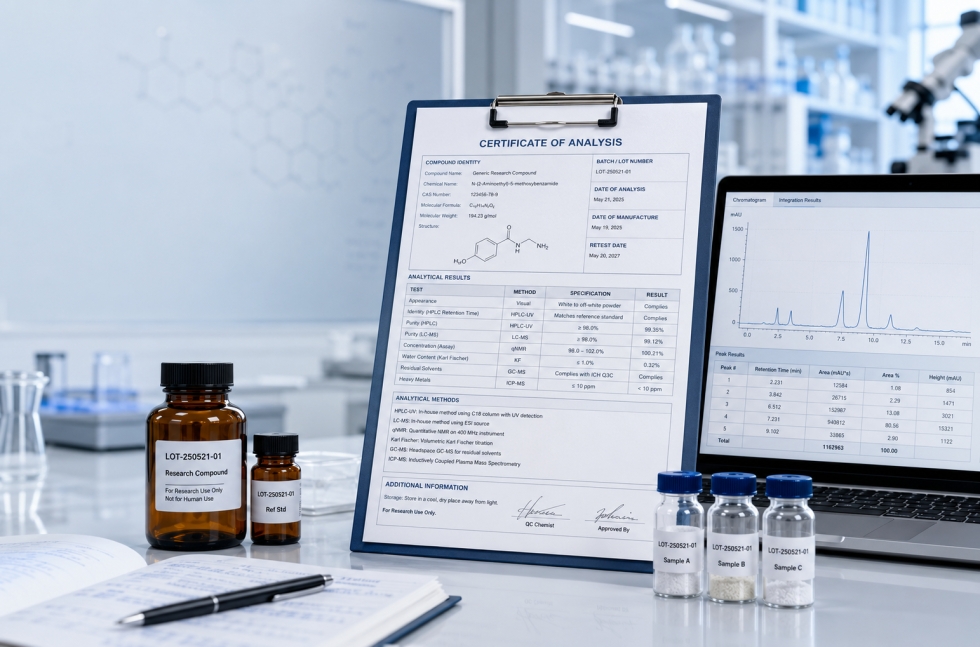
A Certificate of Analysis is a document that reports testing information about a compound, product, or sample. In research-compound sourcing, a COA may provide information about compound identity, purity, concentration, batch reference, testing date, and testing method.
A useful COA may include:
- Compound or product name
- Batch or lot number
- Testing date
- Testing method
- Identity confirmation
- Purity result
- Concentration information where applicable
- Laboratory or testing provider details
The purpose of a COA is to provide supporting documentation. It should help researchers understand what was tested, when it was tested, and what result was reported.
A COA should not be treated as a generic marketing badge. A document that simply says “tested” or “high purity” without supporting details is much weaker than a document connected to a specific compound, batch, and method.
Why Testing Documentation Matters
Testing documentation matters because research compounds are often evaluated based on product identity, purity, format, and concentration. Without clear documentation, researchers have less information to compare suppliers or product listings.
A stronger documentation process can help researchers review:
- Whether the listed compound matches the tested sample
- Whether purity information is available
- Whether concentration details are listed
- Whether the result is tied to a batch or lot
- Whether the testing method is identified
- Whether support can provide documentation when requested
This kind of transparency helps separate documentation-focused suppliers from sellers that rely only on broad claims.
Strong testing documentation does not replace careful research review, but it gives researchers a clearer foundation for evaluating product information.
Compound Identity
Compound identity is one of the most important parts of testing documentation. Identity testing helps support whether the tested material corresponds to the compound being claimed.
For example, if a supplier lists a compound by name, the documentation should make it clear that the tested sample is connected to that compound. Without identity information, a purity result becomes less useful because the reader may not know what the purity percentage actually applies to.
A stronger COA will clearly show:
- The compound name
- The sample or product tested
- The batch or lot reference where available
- The method used for analysis
- The result reported
Identity information is especially important in research-compound categories where different compounds may have similar names, abbreviations, or formats.
Purity Information
Purity refers to the proportion of the tested sample that corresponds to the target compound, based on the testing method and sample used. Purity is often shown as a percentage.
A useful purity result should be connected to supporting details, such as:
- Compound name
- Batch or lot number
- Testing date
- Testing method
- Laboratory or testing provider
- Reported result
A vague “98% pure” claim is weaker than a COA that shows what was tested, when it was tested, and how the result was generated.
Researchers should evaluate purity information as part of the full documentation package. Purity alone does not answer every question. It should be reviewed alongside identity, concentration, batch reference, and method information.
Concentration Details
For liquid research solutions, concentration details are especially important. Concentration refers to the listed amount of compound per unit of solution, often shown as mg/mL.
A product page or documentation record may include:
- Listed concentration
- Total volume
- Product format
- Total listed compound amount
- Batch reference
- COA availability
For example, a 30 mL solution listed at 10 mg/mL is different from a 30 mL solution listed at 25 mg/mL. Clear concentration information helps researchers compare listings more accurately.
Concentration details should be presented for product identification and research comparison only. They should not be presented as dosage instructions, usage guidance, or personal-use recommendations.
Batch and Lot References
Batch or lot references help connect a COA to a specific product group. This is one of the most important traceability details in research-compound documentation.
A batch reference can help answer questions such as:
- Which product group was tested?
- When was the sample tested?
- Does the documentation match the listed product?
- Can the supplier connect a product to its documentation?
- Is the result tied to a specific lot?
A COA without a batch or lot reference may still provide some information, but it is harder to connect the result to a specific product listing. Batch-level documentation supports better organization and supplier accountability.
For research review, batch references make documentation more useful and easier to verify.
Testing Methods
A COA is stronger when it identifies the testing method used. Different analytical methods may be used depending on the compound, sample, and type of analysis.
Commonly referenced methods in research-compound documentation include HPLC and LC-MS.
HPLC, or high-performance liquid chromatography, is often used to separate and quantify compounds in a sample. LC-MS, or liquid chromatography–mass spectrometry, combines chromatographic separation with mass analysis and may provide more detailed compound identification.
Researchers do not need every COA to be written in the same format, but the testing method should be clear whenever possible. A method-based document is generally more useful than a vague claim that a product is simply “lab-tested.”
What Strong Testing Documentation Should Include
Strong testing documentation should be specific enough to support product review. It should help researchers understand what was tested, how it was tested, and how the result connects to the product.
A strong COA or testing document may include:
- Compound name
- Product or sample reference
- Batch or lot number
- Testing date
- Testing method
- Identity confirmation
- Purity result
- Concentration information where applicable
- Laboratory or testing provider details
- Signature or report reference where applicable
A supplier may not present every detail in the same layout, but the more specific the documentation is, the more useful it becomes for research review.
Researchers looking for examples of organized product documentation can review this type of Testing & COA Documentation to better understand how identity, purity, concentration, and batch-level details can support supplier transparency.
Common COA Red Flags
Researchers should be cautious when documentation is vague, incomplete, or difficult to connect to a product.
Common COA red flags include:
- No compound name
- No batch or lot reference
- No testing date
- No testing method
- No purity result
- No concentration information for liquid products
- No laboratory or testing provider details
- Only a generic “lab-tested” badge
- Only a vague purity claim
- No support process for documentation requests
- Documentation that does not match the product listing
A missing detail does not always mean a product is invalid, but multiple missing details can make documentation harder to evaluate.
Product Page Documentation Signals
Testing documentation should also be reviewed alongside the product page. A supplier’s product pages can show whether the catalogue is documentation-focused or marketing-focused.
A documentation-focused product page should include:
- Clear compound name
- Product format
- Listed concentration
- Total volume or quantity
- COA availability
- Research-use-only notice
- Support instructions for documentation requests
- Clear product categorization
A weaker product page may focus on vague claims, exaggerated benefits, personal-use outcomes, or promotional language without supporting documentation.
Researchers should be cautious of product pages that include:
- Dosage instructions
- Cycle guidance
- Bodybuilding recommendations
- Therapeutic claims
- Performance claims
- Transformation language
- User reviews describing physical effects
A research-use product page should help identify and document the product, not encourage personal use.
Why Documentation and Research-Use Boundaries Work Together
Testing documentation and research-use boundaries are closely connected. A supplier can provide COAs, but if the surrounding website promotes personal use, dosage, cycles, or physical outcomes, the overall trust signal becomes weaker.
A stronger supplier should combine:
- Clear testing documentation
- Clear product identity
- Clear concentration details
- Clear support process
- Clear research-use-only positioning
- No usage instructions
- No medical advice
- No bodybuilding or performance claims
This helps create a more professional research environment. It also makes it easier for researchers to separate product documentation from personal-use marketing.
How Researchers Can Compare Suppliers
When comparing research-compound suppliers, researchers should look beyond price and product availability. Documentation quality should be part of the evaluation process.
Useful questions include:
- Does the product page clearly identify the compound?
- Is the product format listed?
- Is the concentration clearly shown?
- Is a COA available?
- Does the COA include a batch or lot reference?
- Does the COA include a testing date?
- Is the testing method shown?
- Is the documentation connected to the listed product?
- Is there a clear support process for documentation requests?
- Does the supplier avoid personal-use claims?
These questions help researchers evaluate supplier transparency more carefully.
Documentation Should Be Specific, Not Promotional
The strongest testing documentation is specific. It does not need exaggerated language to be useful.
A stronger documentation statement may say:
“COA available with compound identity, purity information, concentration details, batch reference, testing date, and method information where applicable.”
A weaker statement may say:
“Guaranteed pure.”
The first statement explains what documentation may show. The second relies on a broad claim without context.
Researchers should look for specific documentation, not just promotional language.
Final Thoughts
Testing documentation is one of the foundations of responsible research-compound evaluation. A useful COA should help researchers understand compound identity, purity information, concentration details, batch references, testing dates, and analytical methods.
For suppliers, strong documentation creates a clearer and more trustworthy catalogue. For researchers, it provides a better framework for comparing products and reviewing supplier transparency.
The most useful research-compound suppliers are not necessarily the ones with the strongest claims. They are the ones that make documentation, product identity, and research-use boundaries clear.
This article was produced exclusively for Muslim Link and should not be copied without prior permission from the site. For permission, please write to info@muslimlink.ca.
This article was produced exclusively for Muslim Link as part of a paid advertising package. For more information on how to advertise through Muslim Link and support the running of Canada's Online Hub go here.