Jun
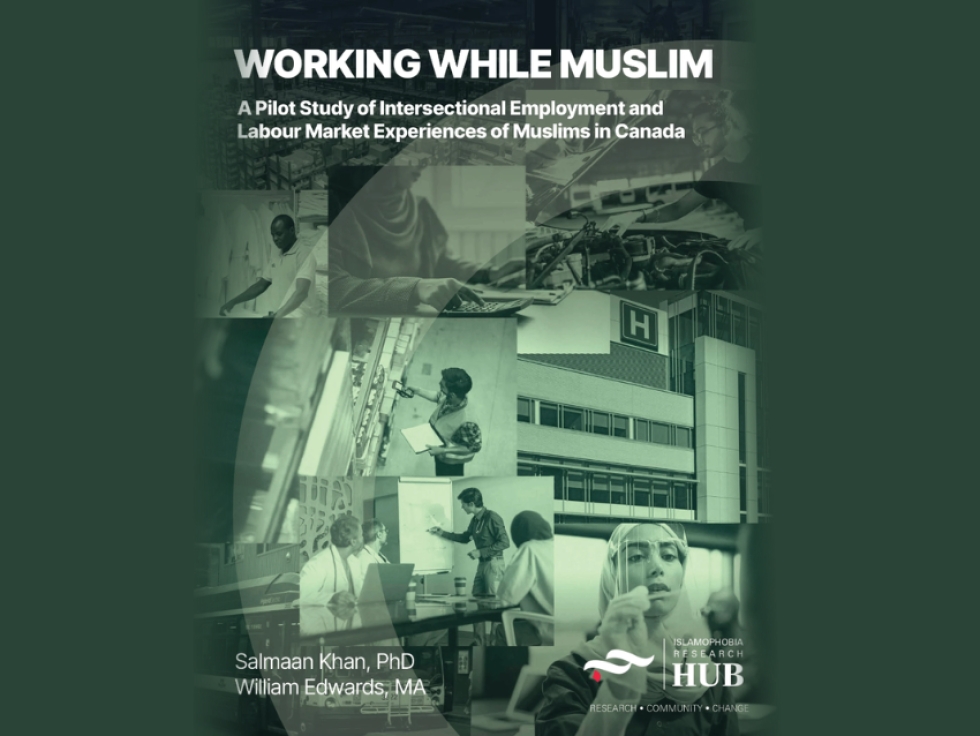
Working While Muslim: New Report from York University’s Islamophobia Research Hub Explores Challenges Faced by Muslims with Employment in the Greater Toronto Hamilton Area
Written by Islamophobia Research Hub at YorkJune 4, 2026 Toronto, ON A new report by York University’s Islamophobia Research Hub, “Working While Muslim: A Pilot Study of Intersectional Employment and Labour Market Experiences of Muslims in Canada” reveals systemic patterns of marginalization, significant income disparities, and workplace discrimination owing to Muslim religious affiliation.
The study was funded by Canada’s former Office of the Special Representative on Combatting Islamophobia, The Muslim Fund, and individual donors.
The geographic scope of this pilot study was the Greater Toronto and Hamilton Area (GTHA).
The 127-page report draws on data from two sources: 1) The 2021 Census of Population; and 2) an original online survey of a sample of 423 Muslims in the GTHA conducted with the assistance of York University’s Institute for Social Research and Leger Opinion.
“The results of this study offer us the insight that what we are experiencing in our conditions of employment is not individual, random, or personal, but part and parcel of a larger and interconnected web of conditions which, in most of the cases, are stacked against us”, said Dr. Salmaan Khan, Postdoctoral Researcher at the Islamophobia Research Hub and co-author of the report.
Findings from the 2021 Census included in the report suggest troubling disparities in economic standing between Muslims and non-Muslims.
Key findings in the report include:
Muslim Wage Gap: Full-time, full-year, prime-age (25-54 years) Muslim workers in the GTHA had a median employment income of $61,000 compared to $73,000 for non-Muslims. This means that Muslim workers earned 84 cents for every dollar earned by non-Muslim workers. When disaggregated by visible minority status, and gender, all groups of Muslim workers had lower median employment incomes than their non-Muslim counterparts, except for South Asian Muslim men. Visible minority Muslim women, working full-time, full-year made 64 cents for every dollar earned by full-time, full-year White non-Muslim men. As a result of the “Muslim Wage Gap,” the study estimates that Muslim workers in the GTHA, their families and their communities experience an aggregate annual loss of $1.2 billion.
Higher Unemployment: The unemployment rate in the GTHA was higher for Muslims (16.4%) compared to non-Muslims (10.2%). When disaggregated by gender, Muslim women had an unemployment rate of 21% compared to 11% for non-Muslim women.
Higher Levels of Poverty: Without using the prime-age restriction, and utilizing Statistics Canada’s Low-Income Measure- After Tax, data from the 2021 Census suggest Muslims (Non visible minority: 18%; Visible minority:17%) are more likely to be classified as ‘low income’ compared to non-Muslims (Non visible minority: 8%; Visible minority: 11%).
Based on original survey data, the report also identifies patterns related to religious accommodation, discrimination, violence and harassment at work, and barriers encountered during job searching or the hiring process.
Weighted survey data estimate that in the GTHA:
- Approximately 1 in 4 (26.7%) Muslims who are active in the labour force, have experienced either verbal or physical violence or harassment while working.
- 1 in 4 (26%) Muslims have experienced discrimination or prejudicial treatment directed toward them while working.
- 52% of Muslims do not feel like their religious practices have been accommodated at work. More than half (56%) of Muslim workers have either sometimes or frequently felt isolated or excluded at work.
- 1 in 4 (25.1%) Muslims have experienced difficulty socializing with their co-workers at, or outside of work.
- 1 in 5 Muslims have been asked about their religious identity or religious practices during a job interview.
“This pilot study is a wake-up call for Canada. As the country strives to be a global economic powerhouse, it is failing to capitalize on the full potential of Canadian Muslims. Canadian Muslims are educated, ready to work and contribute positively, and yet are facing systemic barriers. It's up to every level of government to identify policies and programs that can help overcome these challenges in order to strengthen our country as a whole,” said Amira Elghawaby, Canada’s former Special Representative on Combatting Islamophobia whose office commissioned the study before it was closed.
Reactions to the report from community leaders:
“This research is groundbreaking because it gives us one of the clearest pictures yet of the economic impact that anti-Muslim discrimination can have on ordinary Canadians. When talented people face barriers because of their identity, the consequences are felt not only by families and communities, but by the country as a whole. These findings underscore the need for continued research and meaningful action to ensure equal opportunity for all Canadians,” said Stephen Brown, CEO, National Council of Canadian Muslims (NCCM).
"This study confirms that barriers to employment for Muslims have increased with increasing Islamophobia in our communities. We have been tracking the labour force participation of Canadian Muslim women for 25 years and the situation has worsened. Discrimination and harassment against Muslims, particularly Muslim women, intensify daily due to the current political discourse that permits such behaviour," said Nuzhat Jafri, Executive Director, Canadian Council of Muslim Women (CCMW).
"At a time when Islamophobia is rising across Canada and around the world, this report provides critical evidence of how discrimination is not only experienced in public spaces, but also in workplaces where people seek dignity, opportunity, and economic security. The findings remind us that Islamophobia has real consequences for people's livelihoods, careers, and sense of belonging. Addressing these barriers is essential to building a more equitable and inclusive Canada. It is a call to governments, employers, and institutions to move beyond statements of inclusion and take concrete action to ensure that everyone has an equal opportunity to thrive" said Samya Hasan, Executive Director, Council of Agencies Serving South Asians (CASSA).
The full report is available at: https://www.yorku.ca/laps/research/islamophobia/workingwhilemuslim/